One destination, three journeys
All three sequences tend to zero, but their errors decrease at different rates. The destination alone does not tell us the speed.
A visual math lesson
Three sequences. One limit. Very different journeys.
Check your connection and try again. The full lesson is also explained in text below.
No audio. Choose English visual explanations in the player’s subtitle menu, or read the lesson below.
A fixed tolerance asks whether a sequence converges. A shrinking threshold can also demand a particular speed.
An equivalent explanation of the essential visual reasoning. Follow along, or read at your own pace.
All three sequences tend to zero, but their errors decrease at different rates. The destination alone does not tell us the speed.
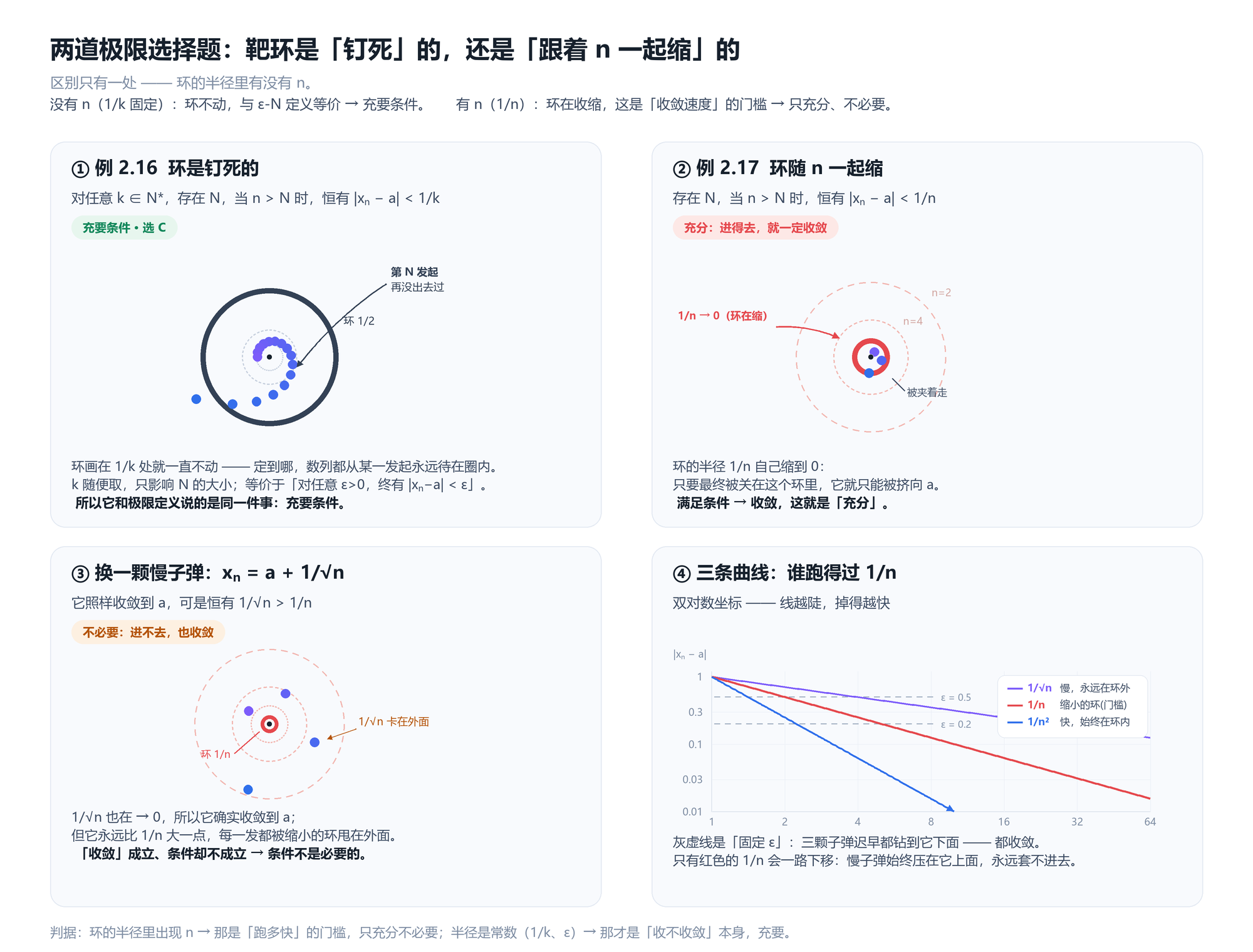
The curves compare 1/√n, 1/n, and 1/n². For large n, 1/√n stays farther from zero, while 1/n² gets close much faster.
A logarithmic view separates curves that seem to flatten together on an ordinary axis. For a power law n to the power −p, the slope on log–log axes is −p. A steeper negative slope means faster decay.
Imagine a fixed ring around the limit a. Convergence means that, for every positive ring radius ε, there is an index N after which every sequence point stays inside that ring. N can depend on ε.
A ring of radius 1/n shrinks as the sequence advances. Eventually staying inside this ring guarantees convergence, but demands more than convergence alone. The sequence 1/√n converges to zero and still stays outside the ring for n > 1. The sequence 1/n² eventually lies inside it. Purple and blue identify compared sequences; the red ring is the threshold.
Requiring eventual entry into every fixed ring of radius 1/k, for every positive integer k, is equivalent to convergence. Requiring eventual entry into the moving ring of radius 1/n is sufficient for convergence but is not necessary.
For the two criteria in this lesson, ask whether the ring radius is fixed while n advances, or shrinks with n. That difference separates a test for convergence from a stronger test that also constrains speed.